
The 2026 Playoffs are here. This year's post-season boasts a tightly-packed field that is hurtling towards explosive showdowns on the court.
Competition in the East is fierce. The Knicks, Pistons and the Celtics have battled for the top seed all season, with the Pistons eventually emerging victorious. The crowded standings mean any chance of reaching the finals will be closely contested - one small mistake could lead to big teams exiting early.
The West has battle-hardened teams, with a wealth of experience on their side. The veterans of the Lakers and the Nuggets will be nipping at the young heels of the Thunder, who enter the playoffs as defending champions and favorites to conquer once again. Not only that, OKC will have to contend with the San Antonio Spurs, who have been within touching distance of the top seed throughout this regular season.
Last year's post season provided unforgettable drama, with the Pacers' incredible run which saw them advance to the finals after defeating the New York Knicks in Game 6. However, it was OKC who seized victory in the finals and established a new dominant dynasty. Can the Thunder repeat or will the Western powerhouse falter and make way for new champions in 2026?
Before the chaos begins, make sure you've got a grip on the rules of the game.
The Rulebook
The Court
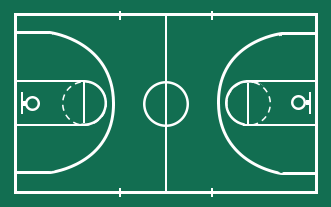
The basketball court is divided into two main sections by the mid-court line, with a hoop at each end. To earn points, each team must get the ball into the opposing team’s hoop.
The ball is moved around the court through passing or dribbling. Traveling, which means moving the ball without dribbling or moving after establishing a pivot foot, is not allowed.
The three-point line is the large semi-circle at the end of each court, and the free throw line is within this semi-circle. Shots made within the three-point line are worth two points, and any successful shots taken from outside are worth three points.
Players
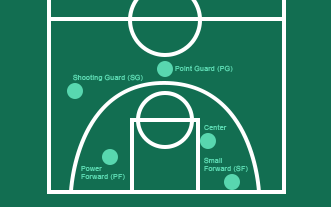
Each team can have five players on the court at any time. These are:
Point Guard – Often the smallest player on the team, and the best at handling and passing the ball. Their aim is to move the ball up the court and initiate attacking play, while setting the team’s pace. Point guards tend to defend the opposition’s best ball handler.
Shooting Guard – The shooting guard needs to be the best at shooting from a distance and scoring 3-pointers. They must also be skilled at defending, and ready to act like a back-up point guard.
Small Forward – These players are often their team’s best scorer, from outside and up-close. They’re great at dealing with rebounds, and they also need to be capable of defending multiple positions.
Power Forward – The power forward drives the team with their strength and explosive skills on court. As well as scoring, power forwards are also crucial for intercepting rebounds and setting screens.
Center – Usually the tallest player on the team, their key roles include blocking, intercepting, and rebounding. They are fast and agile, often scoring close-range shots.
Players can be substituted on from the bench to give breaks to starters, or if a change of strategy is needed. There is no limit to the number of times a player can come in and out of the game.
Timeouts
Timeouts are short stoppages in play that allow coaches to talk to the team. A timeout can be called for strategy changes, to rest, or to stop the opposing team’s momentum. There is a limit to the number of times a timeout can be called, depending on the league.
Scoring
In basketball, there are three main ways to score points:
Three Point Field Goal (Three Pointer) – Three points are awarded to any successful shot taken behind the three point line.
Two Point Field Goal (Two Pointer) – Two points are awarded to any successful shot taken within the three point line.
Free Throws (1 Point) – Free throws are uncontested shots awarded after specific fouls. Either one, two or three free throws can be awarded. Each successful free throw is worth a point.
The Game Clock
Basketball games are divided into halves or quarters of varying times, depending on the league. For example, NBA basketball games are broken down into four twelve-minute quarters.
The game clock stops every time the referee blows the whistle. It also stops at dead balls, which is when the ball is out of bounds, or a foul is committed. This means games take a lot longer than the time on the clock.
-
Shot clock – After a team wins possession of the ball, they have a set amount of time to attempt a shot that hits the rim. If they fail, the possession is automatically given to the opponent. In the NBA, the shot clock is 24 seconds. In the NCAA, it’s 30 seconds.
-
8-Second Rule - A team has 8 seconds to advance the ball from their backcourt to the frontcourt.
-
3-Second Rule – Offensive players cannot remain in the opponent's free-throw lane for more than 3 seconds at a time.
Fouls
Due to the fast-paced nature of the game, fouls in basketball are common.
A personal foul describes illegal contact between two players, such as pushing, tripping, or holding back. Each personal foul committed adds to a player’s total. If they receive more than they are allowed, which depends on the league, they are then fouled out and removed from the game. Personal fouls are the most common type of foul.
A technical foul doesn’t usually involve contact between players but can be given for misconduct like unsportsmanlike conduct and disrespecting the referees. A technical foul can result in one or two free throws and loss of possession.
A flagrant foul is often called for contact that could cause an injury and are deemed unnecessary and excessive. A flagrant 1 foul results in two free throws and possession for the offended team. A flagrant 2 foul has the same consequences, as well as the ejection of the player from the court.
Violations
Violations are non-contact violations of the game’s rules. This can include offenses like stepping out of bounds or backcourt violations. Violations usually result in a throw-in for the offended team.
If you’d like to see the full market rules for basketball, click here.

